Should be pointed out that this is a critique of common popsci journalism tropes and not a fancy new research result. Anyone who has taken a graduate level class in General Relativity would have been able to tell you the same.
I figure at least some of it comes from the idea that mathematically, a singularity is a point (e.g., in the graph of z=1/w, there is a singularity at the point w=0, and in the graph of z=(1-w)²/(1-w) there is a removable singularity at w=1 (that is, the function is undefined at w=1, but if you put a point at (1,0), the graph will be continuous and no longer have any holes in it). The fact that both have the same name and the similar behavior of a black hole singularity to a mathematical singularity¹ can lead people to make an incorrect assumption.
⸻
1. I must admit to a lack of sufficient GR education to feel confident in this, but I think that one of the issues that made physicists unwilling to accept the idea of black holes when they were first postulated was that there ended up being a division by zero in the mathematics.
As someone with basically only popsci knowledge of black holes: people claiming it would be a literal point never made much sense - fundamentally, common sense (as much as it can apply here) dictates that you cannot compress particles to an absolute point.
Common sense cannot be trusted on matters like these. Common sense is calibrated for reasoning over matters encountered in daily life. The further away we get from that, into more and more exotic phenomena, the less common sense can apply. Black holes are very far from the domain of common sense.
The question of "what holds it up?" is where that leads to. There's an interesting history of answering that question again and again - and the discovery of new types of stars each time.
A kugelblitz is a theoretical astrophysical object predicted by general relativity. It is a concentration of heat, light, or radiation so intense that its energy forms an event horizon and becomes self-trapped. In other words, if enough radiation is aimed into a region of space, the concentration of energy can warp spacetime so much that it creates a black hole. This would be a black hole the original mass–energy of which was in the form of radiant energy rather than matter
Rather than compressing particles, would you have difficulty with converting it to incredibly large amounts of energy that wraps space time into a singularity? If you packed enough photons into one spot, that energy would curve space time enough to form a black hole.
Common sense - the experience gained from your common everyday experience of reality - does not apply in black holes.
Common sense would tell you they can't exist at all because you can't compress atoms - you have lived your entire life with atoms being entirely incompressible for the practical purpose of anything you do.
Leaning on common sense to discuss fundamental physics has been wrong since round about the start of the practice of physics.
Kind of, but not really.. though there are simple models with electrons as a point charge, a more accurate model involves the electron field describing the probability of an electron existing at any region in space (not to be confused with the electromagnetic field, the medium in which photons propagate).
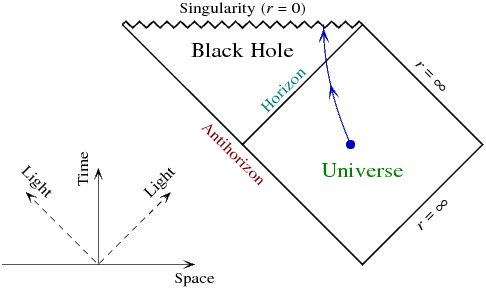
Or read Susskind's "The Theoretical Minimum: General Relativity". For a non-spinning blackhole at least, not only is the singularity not a point, it is a surface in time, not space (as the book explains, the space and time coordinates switch places as you cross the event horizon).
> the space and time coordinates switch places as you cross the event horizon
If Susskind's book does in fact say that, it's extremely disappointing to me, because, as a number of other GR textbooks will tell you (e.g., Misner, Thorne & Wheeler and Wald, the two great classic GR textbooks), the "switch places" is an artifact of a particular choice of coordinates (Schwarzschild coordinates), and does not represent anything physical. So it's not something that should be relied on. (Not to mention the confusion it causes when pop science sources repeat the statement and then draw all manner of wrong conclusions from it.)
The part about being "a surface in time" might be all right, assuming that by that he means "a surface representing a moment in time, not a place in space"--in more technical language, a spacelike surface. That is correct, and it's an invariant that does not depend on any choice of coordinates. But that invariant fact can be described without having to talk about the "switch places" thing at all.
Kruskal-Szeres coordinates indeed get rid of the wonky coordinate stuff at the event horizon, but if you look at the corresponding diagrams, you'll just end up with the same confusion, because the singularity is still a point (or rather surface) in the future instead of a point in space. The issue is that these diagrams are for eternal, static black holes, which cause diagrams to have these weirdly stretched infinite regions that are quite useful for understanding details of the math, but are highly confusing to laypeople. In fact these diagrams make it look like you'll always fall into the black hole at t=infinity, no matter how far you are away, when in reality you could orbit a static black hole pretty close for eternity.
If you really want to get a picture of what is happening, you can look at Eddington-Finkelstein coordinates. In particular at a light cone field diagram around a collapsing shell of matter that turns into a black hole. Then this whole stuff suddenly makes sense without even going into the math. You don't just see how an event horizon can form out of nothing, you also see how gravity starts to bend your causal forward light cone (i.e. all points in spacetime with events that you could interact with in the future) inward in such a way that you will necessarily always fall closer to the center of the mass once you pass a certain line (aka the event horizon).
Roger Penrose (the same guy who also came up with some of the most confusing diagrams) published a beautiful, simple overview of all this in Scientific American: https://www.wkbpic.com/wkbx/SA/1972/1972-05-01.pdf (starting on page 38)
This doesn't seem meaningfully different to me? Like the notion that the singularity is always in your future (because you can't escape it anymore past the event horizon) makes sense, the point of confusion is what are the implications?
Roughly the general public (including me) knows that gravity is meant to have some effect on the apparent passage of time, so it seems significant but under explained what it means to be in a region of space where all possible directions lead to the singularity.
Susskind's book does also mention that the event-horizon shenanigans are due to coordinates and not a physical thing. Certainly I'd trust what he says rather than me, so sorry if I was misleading.
(If anyone has the book, it is chapter 6 section "Interchange of Space and Time Dimensions at the Horizon" and the following section points out the singularity is a time (and you can't escape it (in a Schwartzschild model at least) just like you can't escape time). I'm sorry if my wording is still incorrect.).
The way Brian Cox puts it, a singularity is a point in time: the end of time.
I have trouble really conceptualizing black hole physics, I just think of it as a mass so great that nothing, including light, can escape its gravity. Works for me.
Because it's very misleading. Time and space do not switch places past the event horizon. What happens is that the direction/path between an object and the singularity becomes a timelike dimension, and the direction that plays the role of time outside of the event horizon becomes a spacelike dimension. That is not the same as them swapping or that time becomes space and space becomes time not to mention that space has 3 dimensions and time has only 1 dimension so how could they even swap places.
Really what it means is that past the event horizon you can use the direction in space between you and the singularity as a way to measure time, specifically the amount of time left before you reach the singularity. It's not so mind blowing when you interpret it that way now is it? You can imagine many things in ordinary life that you use to measure time without claiming that time has literally swapped places with it. On a road trip, the number of kilometres to your exit tells you how long you have left, that's using space as a proxy for time... big deal. The notable difference between a road trip and a black hole is that on a road trip you could stop for a break, you could maybe take a detour, you could decide to go back home... and these would all break your use of space as a proxy for measuring time. Well with a blackhole you can't do any of those things, there is no going back, there is no detour, the relationship between the spatial direction towards the singularity and time is fixed and causal and there's nothing you can do about it.
The phrasing used is used almost certainly to evoke some kind of voodoo mind-blowing mystery that completely disappears when you get down to the more strict formalism.
> Really what it means is that past the event horizon you can use the direction in space between you and the singularity as a way to measure time
That's not correct. There is a relationship between the radial coordinate r you are at and the time it will take you, by your clock, to reach the singularity (at least assuming you are freely falling), but that relationship can't be described the way you are describing it.
To put the issue with what you say as starkly as possible: at any event inside the black hole's horizon, there are spacelike curves in every direction from you that will hit the singularity! So "the direction in space between you and the singularity" is not even well-defined.
To be clear, you are right that Susskind's statement is very misleading (I posted my own criticism of it upthread).
Am I understanding this right by thinking - if I was walking toward the black hole past the event horizon, and then I turned around, I would still be walking toward the black hole?
Once you pass the event horizon, every direction leads to the singularity in your future. Directions "away" from the singularity may still visibly show what things looked like outside of the event horizon before you fell in, but that is from your past. Heading in that direction will not get you back there anymore, you will only find the singularity along that path in your future.
it might help to think of the singularity as not a point in space but rather a future that cannot be avoided. All possible paths through space and time, no matter what happens, will go towards the singularity.
I think it's not even a valid critique of that and it's sort of playing games with what the definition of a singularity is to reach the claim that it's making. I think the topology of the singularity is not even a well defined question and certainly not well understood enough to bear the strong claims in the paper.
Unfortunately you are wrong. Everything the paper is saying about the singularity and its properties in GR, and more generally about the black hole solutions it describes, is well understood and has been for decades. The definition of "singularity" that the paper is using is perfectly fine, and its topology is perfectly well-defined. A good textbook treatment is that of Wald (1984).
Some of the things the paper points out are not emphasized in other sources, which is probably why the authors chose to write it. But there is nothing in the paper that is in the least questionable or ill-defined; it's all standard General Relativity as applied to the Schwarzschild and Kerr black hole solutions.
This is the opinion of most physicists, yes, but it does not in any way justify the GP's claims or cast doubt on anything that is said in the paper. Note that the paper talks explicitly about the limitations of GR as the singularity is approached and how a quantum gravity theory, if we ever find and confirm one, might fix those issues.
It's not? Schwarzschild has a space-like singularity. That's the wiggly horizontal line at the top left of the diagram. If you are in the black hole you can't avoid hitting it. Seems to be exactly what the paper is remarking on.
Off-topic, but it makes me think of "reasoning black holes": you get enough like-minded people together that they start reinforcing each other's logic and beliefs until not only those people get completely detached from reality, but anyone who interacts with them gets sucked in as well unless their own logic ("velocity") is adequate to skirt the edge and escape, forever altered by the experience.
Similar questions arise: how would you know if you were inside one? The laws of logic ("physics") seemingly don't apply, but there's no way to test them in that environment.
Would this apply also to the singularity at the beginning of the universe? I guess I thought that the singularity was where all matter is compressed so much that it occupies a zero dimension point. I'm not sure if that applies equally to black holes and the singularity at the beginning of the universe. I'm kind of dumb on this stuff even though it fascinates me.
Rolling the clock backwards toward the big bang, it is not matter which is directly compressed, it is the fabric and metric of space itself. Matter being compressed is merely a side effect of the fact that "all of the locations that the matter occupies" are also compressed (though again, remain aware that calling it "compression" only makes sense when you rewind time in our cosmological model backwards).
So it is not as though you and the Andromeda Galaxy are made out of matter that got flung out of a point explosion long ago so that now you have traveled a very long distance away from one another, it is more like "both you and the Andromeda galaxy sat still for 13.8 billion years but space expanded between you in that time, so originally you were right on top of each other along with everything else".
We can rewind the model until the entire observable universe was as small as a Planck volume, but we have abundant evidence that the universe is indefinitely larger than that so even "that time when our 98gly diameter patch of space was almost indistinguishable from a mathematical point" means little when even that "point" was still just one pinprick out of the smooth manifold of a larger universe which could have been stupidly large or infinite even that early on.
The big bang didn't happen at a single point, it happened everywhere. You can look out from anywhere and see the cosmic background radiation having expanded from your location, wherever that location might be.
Normally people think of gravity as pulling on objects. You can instead think of it as pulling on the space those objects are in.
A black hole happens when there is enough gravity that space gets pulled inwards somewhere, at at least the speed of light.
Gravity falls off with distance, and the distance where space is being pulled inwards at exactly the speed of light is called the "event horizon".
It has this name because speed of light is the speed of causality: events that happen further in, are "over the horizon" for you, they cannot causally influence you.
> Normally people think of gravity as pulling on objects. You can instead think of it as pulling on the space those objects are in.
(Very uneducated person here) I’ve always wondered if large objects caused gravity, or if maybe large objects form in the places where there is a lot of gravity. This is probably elementary, but I’ve never looked in to it. Maybe today is the day!
It's a region of space from where not even light can scape.
You can get a region like that by squashing a lot of mass in a small space, like happens when a star collapses under its own gravity. So here the intuition of "high density" makes sense.
But at the center of galaxies you have the so called "supermassive black holes" which are more or less comparable in size to the solar system and yes, they have a lot of mass but they are not very dense, a pop-sci trope is comparing it's density to cotton candy or even the air we're breathing right now.
So it's a matter of how you distribute mass/energy in a given diameter, not exactly of density.
The problem there is that not even the physicists completely agree on the details, because we know black holes definitely exist, but every explanation breaks one rule or another that should apply from different disciplines. It's part of why they get so much ongoing attention.
Black holes are essentially where our knowledge of spacetime breaks, and we can’t even see into it. It’s hard to really concretely know much about it directly.
Consider a balloon. I don’t imagine in visuals but if you do, either a solid color or a patterned balloon works. Let’s say it’s a cow print design.
Deflate it, then stretch the balloon over a vacuum cleaner tube and put on a rubber band to keep it in place.
If you pour sand on it, you can only get a small bump of sand and then it’ll run off the sides. Reasonable, logical, normal behavior. Clearly it’s a surface — it’s holding sand, it’s pouring sand in different directions over the edge, the sand is not all compacted into a single grain.
Turn on the vacuum cleaner. Assume a balloon stretchier than the strongest vacuum cleaner in the universe. What happens? Several things, each of which are perfectly reasonable:
1) The end of the tube is still a circle, and the balloon is still attached and covering the tube, so it’s still a two-dimensional circle.
2) A single grain of sand can’t block the vacuum tube, so it clearly hasn’t collapsed to a point.
3) The covered end of the vacuum cleaner tube is still the same circle, with the same diameter, as it was before you turned on the vacuum.
4) You can pour buckets more of sand onto that stretched circle of balloon than the handful you could before.
5) If you pour enough sand onto the circle, it’ll behave just like it did before: the sand will form a small mound and then newly-poured sand will run off whichever side the sand was poured on.
6) The rubber band is going to catch some of the overflowing grains of sand and hold onto them (‘accretion’), near but just outside the circle.
Next: Consider a more powerful vacuum cleaner. How much more? Lots. The most. An atomic Dyson powered by nuclear fusion. (This is a bit unrealistic, but that’s astrophysics for you.)
How much sand can you pour onto that two-dimensional, circular, balloon surface?
Lots. The most. Some of it will spill around the edges and get caught in the accretion band, but somehow that circle, that’s still the same size and clearly still blocking the vacuum tube, can hold an entire universe of sand.
That’s how black holes work :)
ps. For those who dislike the crudity of my teaching analogy and want to pop the spherical cow balloon: Topologically, the surface covering the vacuum tube is always a circle, even if you have an infinitely-powerful vacuum cleaner. At no point — pun intended — can a vacuum cleaner apply a transformation applied that reduces the dimensionality of the surface, thus it must remain, topologically, a circle.
pps. So clearly I must choose the circle in front of me! Hahaha! Aaaahahahah!
"A really interesting and cool thing for astronomers to talk about...but you might want to pray that not one of 'em ever comes within a million trillion miles of the Earth."
Astronomical distances are vast, million trillion miles too far, that's over a hundred thousand light years. There are known stellar-mass black holes within just 2000 light years of the Earth. Heck, there might be a primordial black hole in the inner Oort cloud and not only would it not destroy earth, we'd have (are having) trouble detecting it.
Unfortunately, there is a rather large one not one sixth of that distance away (a million trillion miles is actually rather large - 170 kly - approximately double the size of our galaxy)
Yes - I took the grandparent comment's "descr to a non-physicist" as "describe to someone who really isn't into math or hard sciences". Those folks will hear "million trillion" as "a really Really REALLY REALLY big number". Not as "1 x 10^18".
so in theory a spinning black hole that's been around for billions of years has a time drag around it in a path that is billions of years old
(no we can't navigate it because yes that would be time travel to the past and violates causality)
black holes are just so weird with every new detail even more weird
oddly more interesting to me to try to grasp neutron stars (densest objects before black holes and are still visible, our entire solar system in a neutron star would be only 10km 6.2miles across)
Yes, magnetars are considerably more rare than black holes and considerably more interesting to study in terms of raw horsepower. Imagine a type-2 civilization using them as engines or launchers for spacecraft to zip around the galaxy.
Another thing that may blow the minds of some is that M87* is less dense than air at 0.44kg/m³ so if you could bring it to sea level (in a large enough theoretical test area) it would float like a helium balloon (sea level air is 1.2kg/m³).
Of course if you did do that, the air itself would collapse into a black hole larger than M87*...
It blows my mind that, in the frame of an outside observer, time appears to stop at the event horizon. An observer falling through the horizon (who survived the radiation and tidal forces) would not perceive this.
Well... yeah? That's describing the event horizon. It's a term roughly as widely used as "singularity".
Talking about the inside of a black hole is indeed rather pop-misunderstood though, yes. But it's not like physicists are especially confident about the details either. Theoretical astrophysics changes a lot as time goes on and our instruments improve, and it's a rather hard field to do experiments on to get better data quicker.
No, sorry, the singular surface in a Schwarzschild spacetime is not the event horizon. Nothing particularly interesting (from the GR point of view) happens at the event horizon.
Interesting work. The idea that the singularity is a surface rather than a point was unexpected to me even though it seems to follow logically from the theory of relativity.
I wonder how this reconciles with quantum gravity. If the singularity is truly a two-dimensional surface, perhaps it's related to Hawking radiation and the thermodynamics of black holes?


reply